ABOUT US
The Renewable Alcohol Combustion Collaboration is an international partnership dedicated to improving the understanding of alcohol combustion engines. Our mission is to drive innovation and sustainability for alcohol engine applications through research, development, and collaboration. Below is a description of each of the key founding collaborators in alphabetical order. If you and your organization are interested in joining the collaboration, please email one of the members below.

Clemson University constructed the Clemson University International Center for Automotive Research (CU-ICAR) campus in ~2007. In 2019, CU-ICAR expanded its engine-combustion team and began investigating the alcohols in compression ignition and spark ignition strategies through the Advanced Combustion and Renewable Fuels Lab. The group consists of Professor Benjamin Lawler, Professor Brian Gainey, and their PhD students and technical staff.
For more information, please visit: https://cecas.clemson.edu/acrf/
or contact: bjlawle@clemson.edu or bgaine2@clemson.edu


Ghent University has focused on methanol combustion for a variety of applications, including their recent FASTWATER project, led by Professor Sebastian Verhelst, which explored methanol's use in marine applications. Some photos of Ghent's facilities are shown below.
Please see Ghent's Transport Technology page for more information, or contact: Sebastian.Verhelst@UGent.be


Lund University in Sweden has a long history of engine combustion research insights and findings, with several influential faculty members contributing to Lund's impact over the years. For the ReAC Collab., Professor Martin Tuner, is the main point of contact, with Professor Verhelst and Professor Brian Gainey both having joint appointments at Lund, in addition to Ghent and Clemson.
For more information, please contact: martin.tuner@energy.lth.se

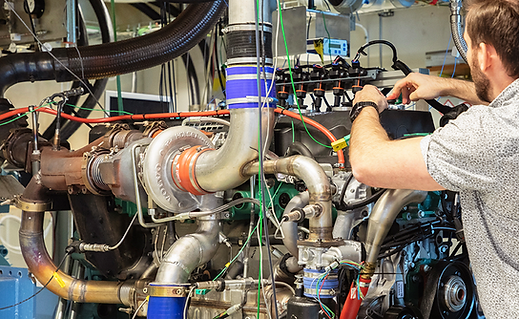


Prof. Adam Dempsey and Prof. Casey Allen at Marquette University have led multiple projects exploring ethanol compression ignition using a variety of ignition aids – such as exhaust rebreathe and an actively fueled prechamber on a heavy-duty Caterpillar single-cylinder engine. They also have used a rapid compression machine for fundamental ignition delay and soot laser extinction measurements associated with the alcohols, as well as high speed imaging within an optical actively fueled prechamber.
For more information, please contact:
casey.allen@marquette.edu or


Sandia National Laboratories (SNL) has their Combustion Research Facility (CRF) which uses advanced optical diagnostics that have led to numerous impactful findings for the combustion research community over the years. Recently, Dr. Dario Lopez Pintor has embarked on methanol and ethanol experiments and chemical kinetics modeling to improve the understanding of alcohol combustion.
For more information, please visit:
https://crf.sandia.gov/ or contact:
dlopezp@sandia.gov


The University of Wisconsin-Madison and the Engine Research Center has a long history of developing compression ignition engine technologies, including for alcohol fuels. Prof. Adam Dempsey’s research program on ignition for alcohol fuels has moved to UW-Madison. The development of prechamber enabled mixing-controlled combustion (PC-MCC), among other ignition assistance technologies for heavy-duty alcohol engines will continue at UW-Madison within the Engine Research Center.
For more information, please contact: abdempsey@wisc.edu


Renewable Alcohol Combustion Collaboration
ReAC Collab.